
Melanoma, the most serious skin cancer, develops on skin that gets too much sun. It can also begin in places where the sun rarely shines, such as your foot. Because most people never check their feet for signs of melanoma, this cancer often spreads before it’s noticed.
Allowed to spread, melanoma can turn deadly. By checking your feet, you can find it early when it’s highly treatable. Here’s what you need to know to find melanoma on your feet.
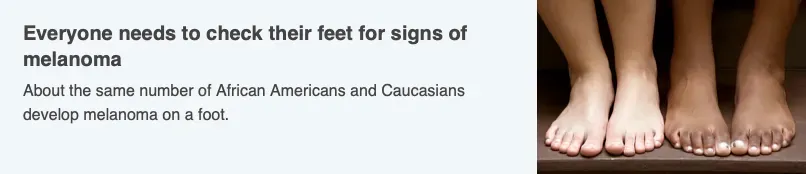
Everyone needs to check their feet for signs of melanoma
People of all races and colors get melanoma on their feet. In fact, about the same number of African Americans and Caucasians develop melanoma on a foot.1 For people of African or Asian ethnicity, the feet and hands are the most common places for melanoma to appear.2
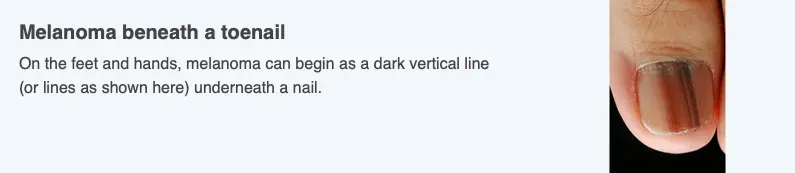
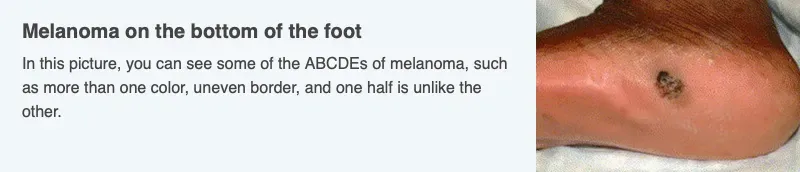
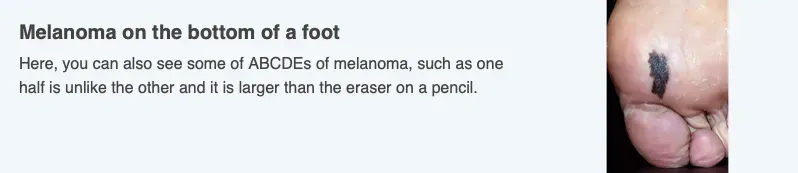
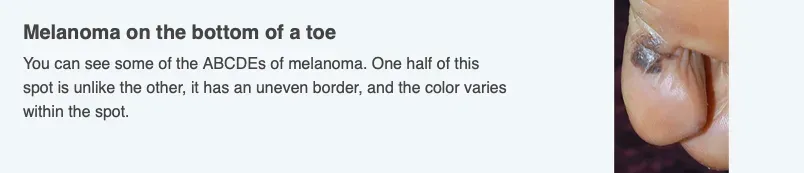
A board-certified dermatologist is the skin cancer expert
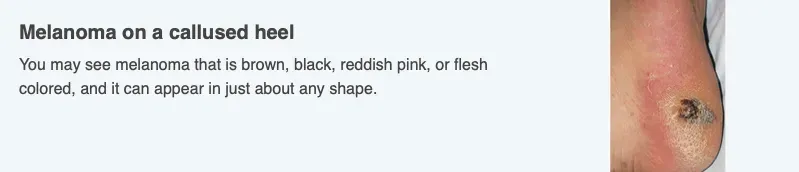
If you find a spot, growth, or sore that could be a melanoma on your foot, you want to see a board-certified dermatologist. On the foot, melanoma can be mistaken for a number of things, including a wart, normal pigment beneath a toenail, callus, non-healing wound, or another skin problem.
A board-certified dermatologist has the tools needed to get a closer look at a suspicious spot on your skin. By using a dermoscope or Wood’s lamp, a dermatologist can see patterns that one cannot see with the naked eye.
By seeing a board-certified dermatologist, you can also be reassured that you are seeing the medical doctor who has received the most training and experience in diagnosing skin cancer.
If you find a suspicious spot on your foot, you can locate a dermatologist near you by going to, Find a dermatologist.
Related AAD resources
How to check your nails for melanoma
Images
Images 1-2: Getty Images
Images 3,4,5,7,8: Used with permission of the Journal of the American Academy of Dermatology:
J Am Acad Dermatol.2018;78(1):179-182.e3
J Am Acad Dermatol. 2006;55(5):741-60
J Am Acad Dermatol. 2017;76(2):S34-6
Image 6: Used with permission of DermNet New Zealand
References
Desai A, Ugorji R, et al. “Acral melanoma foot lesions. Part 1: epidemiology, aetiology, and molecular pathology.” Clin Exp Dermatol. 2017;42(8):845-8.
Desai A, Ugorji R, et al. “Acral melanoma foot lesions. Part 2: Clinical presentation, diagnosis, and management.” Clin Exp Dermatol. 2018;43(2):117-23.
Lambert Smith J, Wisell J, et al. “Advanced acral melanoma.” JAAD Case Rep. 2015;1(3):166-8.
Madankumar R, Gumaste PV, et al. “Acral melanocytic lesions in the United States: Prevalence, awareness, and dermoscopic patterns in skin-of-color and non-Hispanic white patients.” J Am Acad Dermatol. 2016;74(4):724-30.
Merkel EA and Gerami P. “Malignant melanoma of sun-protected sites: a review of clinical, histological, and molecular features.” Lab Invest. 2017;97(6):630-5.
Persechino F, Longo C, et al. “Acral melanoma.” J Am Acad Dermatol. 2017;76(2) suppl 1: S34–6.
Shin TM, Etzhorn JR, et al. “Clinical factors associated with subclinical spread of in situ melanoma.” J Am Acad Dermatol. 2017;76(4):707-13.
Sondermann W, Zimmer L, et al. “Initial misdiagnosis of melanoma located on the foot is associated with poorer prognosis.” Medicine (Baltimore). 2016;95(29):e4332.
Washington CV, Mishra V, et al. “Melanomas.” In: Taylor SC, Kelly AP, et al. Taylor and Kelly’s Dermatology for Skin of Color (second edition). McGraw Hill Medical, New York, 2016:312-5.