
DIABETES: 10 WARNING SIGNS THAT CAN APPEAR ON YOUR SKIN
Diabetes can affect many parts of your body, including your skin. When diabetes affects the skin, it could mean that:
- You have undiagnosed diabetes or pre-diabetes.
- Your treatment for diabetes needs to be adjusted.
It’s time to talk with your doctor if you notice any of these warning signs on your skin.
1. Shin spots
This skin condition is common in people who have diabetes. The medical name for shin spots is diabetic dermopathy. You may also hear people refer to this condition as spotted leg syndrome.
When this condition begins, you usually see round or oval spots, which often develop on the shins. The spots may be brown or reddish brown in color.
Early on, these spots often feel scaly. As they flatten out, they can cause small dents in the skin.
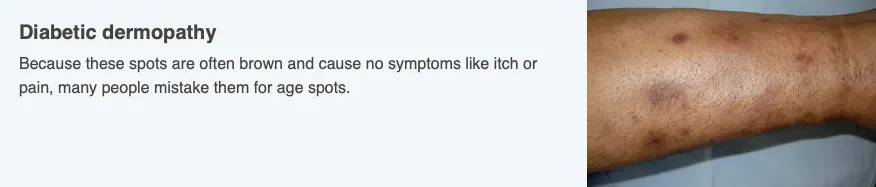
Unlike age spots, these spots often start to fade after diabetes is well-controlled, usually within 18 to 24 months. Diabetic dermopathy can also stay on the skin indefinitely.
While these spots are harmless, anyone who develops them and hasn’t been diagnosed with diabetes should be tested.
If you have diabetes, tell your doctor about these spots. Some people who have diabetes and shin spots have a higher risk of developing complications from diabetes like neuropathy, which is nerve damage that can lead to weakness, numbness, and pain.

2. Darker area of skin that feels like velvet.
A dark patch (or band) of velvety skin on your neck, armpit, groin, or elsewhere could mean that you have too much insulin in your blood. This is often a sign of pre-diabetes. The medical name for this skin condition is acanthosis nigricans.
3. Hard, thickening skin
If you have diabetes, hard, thick, and swollen-looking skin can develop, even when diabetes is well controlled. The medical name for this condition is scleredema diabeticorum.
Often developing on the upper back, the skin thickens and tightens slowly over months or years. This condition can also occur on the shoulders, neck, or elsewhere, but never on the hands or feet.


4. Open sores and wounds.
Having high blood sugar (glucose) for a long time can lead to poor circulation and nerve damage. You may have developed these if you’ve had uncontrolled (or poorly controlled) diabetes for a long time.
Poor circulation and nerve damage can make it hard for your body to heal wounds. This is especially true on the feet. The open wounds are called diabetic ulcers.

5. Outbreak of small bumps
Uncontrolled diabetes can cause extremely high levels of triglycerides, a type of fat that circulates in the blood. If this happens, you can develop a skin condition called eruptive xanthomatosis.

After the bumps appear, they soon develop a yellowish color in lighter skin tones. If you have a darker skin tone, you may see a grayish color with a yellowish hue beneath. You’ll usually find these bumps on the buttocks, thighs, crooks of the elbows, or knees. They can form anywhere though. No matter where they form, they are usually tender and itchy.
Once the diabetes is well-controlled, the bumps tend to go away.

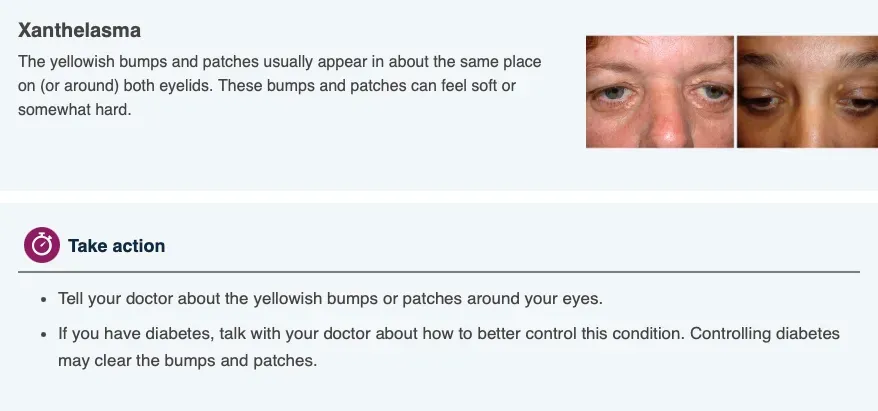
6. Yellowish, smooth bumps or patch(es) on and around your eyelids.
These bumps and patches develop when you have high levels of fat in your blood, which can be a sign that you have poorly controlled diabetes. The medical name for this condition is xanthelasma.
Regardless of your skin tone, these bumps and patches look yellowish or yellowish orange in color.
7. Infections
Diabetes weakens your immune system, which reduces your body’s ability to fight off harmful germs and increases your risk of developing infections. Fungal infections like oral thrush and yeast infections of the vagina are common.

8. Skin tags
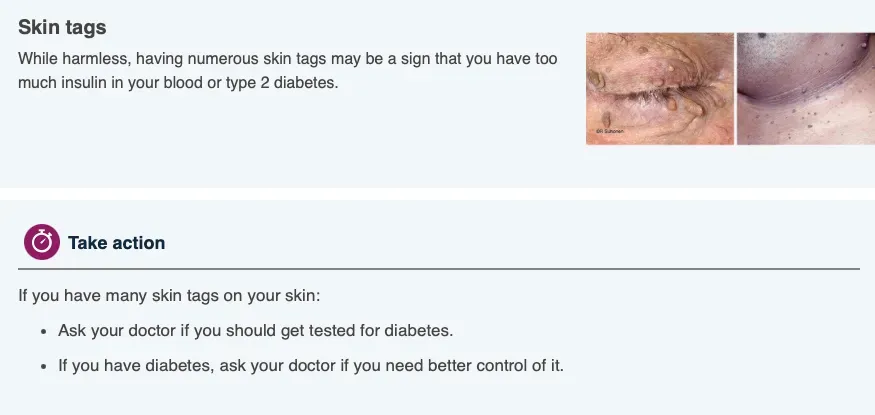
Many people have skin tags, which are harmless growths that can appear anywhere on the skin. Sometimes, skin tags are firmly fixed to the skin. You may also see ones that dangle from a stalk. The medical name for these growths is acrochordons.
While skin tags can develop anywhere on the skin, they are most common on the eyelids, neck, armpit, and groin.
9. Cluster of small bumps or a raised patch
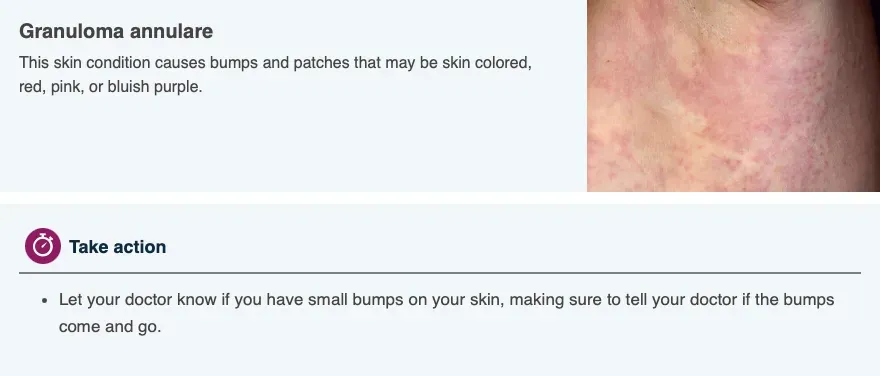
Whether this skin condition is associated with diabetes is controversial. We know that most people who have granuloma annulare do not have diabetes.
Several studies, however, have found this skin condition in patients who have diabetes. One such study found that people with diabetes were most likely to have granuloma annulare over large areas of skin and that the bumps came and went. Another study concluded that people who have granuloma annulare that comes and goes should be tested for diabetes.
10. Yellow, reddish, brown, or purplish patches on your skin
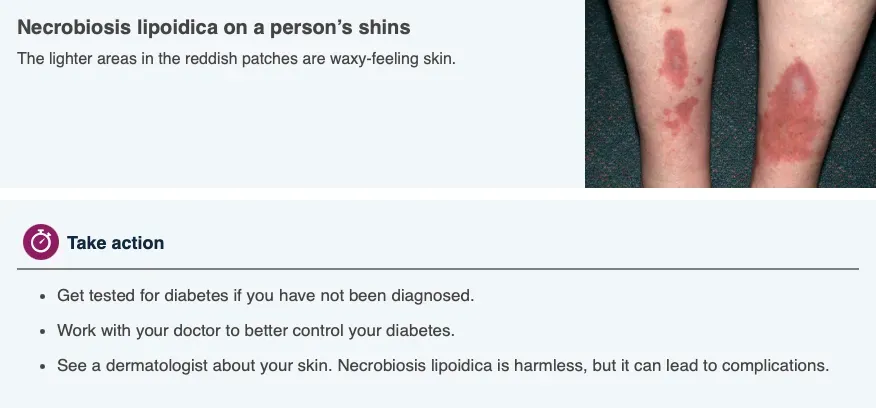
When this condition begins, you’ll often see one or a few reddish-brown spots on your shins if you have a lighter skin tone. People with darker skin tones often see purplish spots. These spots aren’t itchy or painful. The medical name for this condition is necrobiosis lipoidica.
These spots grow slowly, becoming one or more patches that may be yellow, reddish, brown, or purplish. In the center, you may see waxy skin that is thinning, blood vessels, or both.
When to see a dermatologist
Diabetes can cause skin problems. Most of these skin problems are harmless, but even a minor one can become serious if you have diabetes. A board-certified dermatologist can recognize skin problems due to diabetes and help you manage them.

Images
- Images 1, 2, 6, 8, 9, 11, 12, 13, 14: Reproduced with permission from ©DermNet www.dermnetnz.org 2023.
- Image 3, 4: Used with permission of the Journal of the American Academy of Dermatology:
- J Am Acad Dermatol 2007;57:502-8.
- J Am Acad Dermatol 2014;71:e99-e101.
- Images 5, 10: Getty Images
- Image 7: Used with permission of the American Academy of Dermatology National Library of Dermatologic Teaching Slides.
References
Centers for Disease Control and Prevention. “ Diabetes and your feet.” Last updated 4/11/2023. Last accessed 11/28/2023.
Cohen Sabban, EN. “Cutaneous manifestations of diabetes mellitus from A to Z.” Focus session presented at: 74th Annual Meeting of the American Academy of Dermatology; March 4-8, 2016; Washington D.C.
Duff M, Demidova O, et al. “Cutaneous manifestations of diabetes mellitus.” Clinical Diabetes. 2015;33:40-8.Lima AL, Illing T, et al. “Cutaneous manifestations of diabetes mellitus: A review.” Am J Clin Dermatol. 2017 Aug;18(4):541-53.
Martín C, Requena L, et al. “Scleredema diabeticorum in a patient with type 2 diabetes mellitus.” Case Rep Endocrinol. 2011;2011:560273.
McKinley-Grant L, Dronavalli S, et al. “Cutaneous manifestations of systemic disease.” In: Taylor and Kelly’s Dermatology for Skin of Color. (second edition). McGraw Hill, USA, 2016:479-85.
Morgan AJ and Schwartz RA. “Diabetic dermopathy: A subtle sign with grave implications.” J Am Acad Dermatol. 2008;58:447-51.
Pereira M, Pinheiro RR, et al. “Scleredema diabeticorum.” Dermatol Reports. 2022 Nov 21;14(4):9477.
Vangara SS, Klingbeil KD, et al. “Severe hypertriglyceridemia presenting as eruptive xanthomatosis.” J Family Med Prim Care. 2018 Jan-Feb;7(1):267-70.
Written by:
Paula Ludmann, MS
Reviewed by:
Brendan Camp, MD, FAAD
Amanda Friedrichs, MD, FAAD
William D. James, MD, FAAD
Omolara Olowoyeye, MD, FAAD
Last updated: 1/4/24